Anest Iwata built the first air-cooled, oil-free scroll vacuum pump and has sold the ISP line into laboratories, analytical instruments, and industrial roughing duty ever since. Four frame sizes share one compression principle, one wear-part strategy, and one maintenance rhythm — this page lays out all three.
Every ISP pump is the same scroll-and-motor architecture scaled up or down. Icon size below is scaled roughly to each pump’s shipping weight, so the lineup reads the way it sits on a bench or a rack.
600 L/min · 21.2 CFM
7.5×10⁻³ Torr ult.
62 dB(A) · 44 kg
600 L/min · 21.2 CFM
7.5×10⁻³ Torr ult.
62 dB(A) · 44 kg
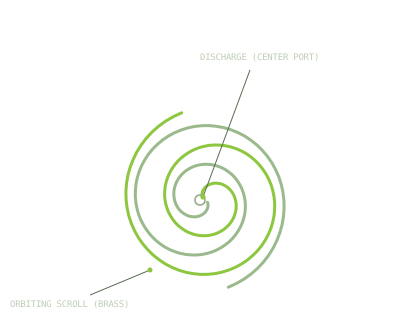
Every ISP pump uses the same pair of interleaved spiral scrolls: one fixed, one orbiting. The orbiting scroll is driven in a small circular path by an eccentric crank — it never rotates on its own axis. As it orbits, crescent-shaped gas pockets form at the outer edge of the scroll set, then get carried inward and progressively squeezed as the orbit continues.
By the time a pocket reaches the center, it has been compressed to near-atmospheric pressure and is pushed out through the discharge port. Because the two scrolls only meet at their PTFE tip seals, the compression chamber never sees oil — which is the entire basis of the pump’s oil-free operation.
An air flush circuit, standard on every ISP pump, continuously purges a small volume of filtered air through the back of the scroll set and bearing area, keeping process gas and particulate away from the crank mechanism.
Compiled from published distributor datasheets for the ISP-90 through ISP-1000. Treat as a planning reference — confirm exact figures against the current OEM datasheet for your unit before specifying.
| Characteristic | ISP-90 | ISP-250 | ISP-500 | ISP-1000 |
|---|---|---|---|---|
| Pumping speed, 60 Hz | 108 L/min (3.8 CFM) | 300 L/min (10.6 CFM) | 600 L/min (21.2 CFM) | 1200 L/min (42.4 CFM) |
| Pumping speed, 50 Hz | 90 L/min (3.2 CFM) | 250 L/min (8.8 CFM) | 500 L/min (17.7 CFM) | 1000 L/min (35.3 CFM) |
| Ultimate pressure | 5 Pa (3.7×10⁻² Torr) | 1.6 Pa (1.2×10⁻² Torr) | 1.0 Pa (7.5×10⁻³ Torr) | 1.0 Pa (7.5×10⁻³ Torr) |
| Noise level | 52 dB(A) | 58 dB(A) | 62 dB(A) | 68 dB(A) |
| Water vapor capacity | 5 g/day | 25 g/day | 25 g/day | 25 g/day |
| Weight (single-phase) | 14 kg (31 lb) | 25 kg (55 lb) | 44 kg (97 lb) | 3-phase only * |
| Weight (three-phase) | 23 kg (51 lb) | 38 kg (84 lb) | 68 kg (150 lb) | not listed in source * |
| Voltage | Single or 3-phase: 200/208/230/380/400/415/460V (3-ph) | Three-phase: 200/208/230/380/400/415/460V | ||
| Ambient temperature | 5–40°C (41–104°F) | 10–40°C (50–104°F) | ||
| Standard equipment | Air flush attachment and running-hour meter on every model; thermal protection standard on all single-phase units | |||
* ISP-1000 ships three-phase only. Some source datasheets merge cells across models for connection sizes and leak-tightness figures — those two rows are omitted here rather than guessed at; pull them from the OEM sheet for a specific unit.
Being dry pumps, ISP units don’t have an oil-change schedule — but the scroll set still has wear items on a clock. Distributors servicing these pumps report a consistent two-tier interval across the family.
Routine check
Hours, or 1 year — whichever first
Hours, or 2 years — whichever first
Warranty note: tip seal wear is treated as a normal consumable, not a defect — most service shops flag that OEM warranty coverage doesn’t extend to tip seal replacement, since the part is expected to reach end of life well inside a typical warranty period.
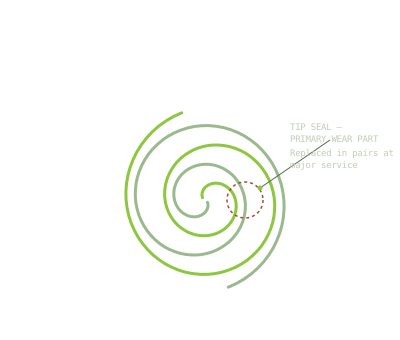
A thin PTFE tip seal runs along the top edge of each spiral, riding against the opposing scroll wall to hold the seal between adjacent gas pockets. It’s the only place in the pump where the two scrolls make contact, which makes it the part that wears fastest and the one that sets how deep the pump can still pull once it’s been running a while.
Interval: OEM guidance calls for tip seal replacement at roughly 8,000 hours of running time — a little under a year of continuous duty — to hold the pump’s rated ultimate pressure.
Run-in: after a tip seal change, run the pump for around 40 hours before judging final performance — new seals need a break-in period to seat fully against the scroll wall.
Replaced as a pair: the fixed-scroll and orbiting-scroll tip seals wear together and are sold and swapped as a matched set, not individually.
OEM guidance alternates minor and major service every 8,000 hours, based on whichever comes first — the elapsed years or the running hours — until the unit is due for replacement at year six.
| Year | 1 | 2 | 3 | 4 | 5 | 6 |
|---|---|---|---|---|---|---|
| Hours | 8,000 | 16,000 | 24,000 | 32,000 | 40,000 | 48,000 |
| Service | Minor | Major | Minor | Major | Minor | Replace |
OEM guidance alternates minor and major service every 8,000 hours, based on whichever comes first — the elapsed years or the running hours — until the unit is due for replacement at year six.
Part numbers and kit descriptions.
| Item | Material / Description |
|---|---|
| 98882590 | ISP90 Major Service Kit |
| 98881590 | ISP90 Minor Service Kit |
| 98885570 | ISP90 Tip Seal Kit |
| 98885580 | ISP90 Crank Shaft Kit |
| 98883580 | ISP90 Pin Crank Kit |
| 98883251 | ISP250C Major Service Kit |
| 98884251 | ISP250B/C Minor Service Kit |
| 98882270 | ISP250B/C/E Tip Seal Set |
| 98882260 | ISP250B/C Crank Shaft Kit |
| 98883131 | ISP250B Pin Crank Kit |
| 98882251 | ISP500B/C Major Service Kit (replaces #98882250) |
| 98881251 | ISP500B/C Minor Service Kit |
| 98883240 | ISP500B Tip Seal Set |
| 98883230 | ISP500B Crank Shaft Kit |
| 98885230 | ISP500B Pin Crank Kit (alternate item) |